
When doubling a slot stake doubles an award—and when it does not
Doubling a stake doubles an award only when the applicable rule scales proportionally with that stake and nothing else changes. A paytable number displayed in credits, cash or a stake multiple cannot be compared until its unit is identified.
This guide isolates the unit question. It uses invented paytable rows, not a claim about the configuration of a named slot.

Read the label beside the award
Suppose the same qualifying combination is described in two hypothetical ways: “pays 6 times total stake” or “pays 30 credits.” The first explicitly names a monetary base. The second still needs a credit value and the relevant stake settings.
The UK transaction-display standard distinguishes unit stakes, total stakes and credit conversion. It is a British technical reference, not evidence that a particular local game has been checked.
Hold every other condition fixed
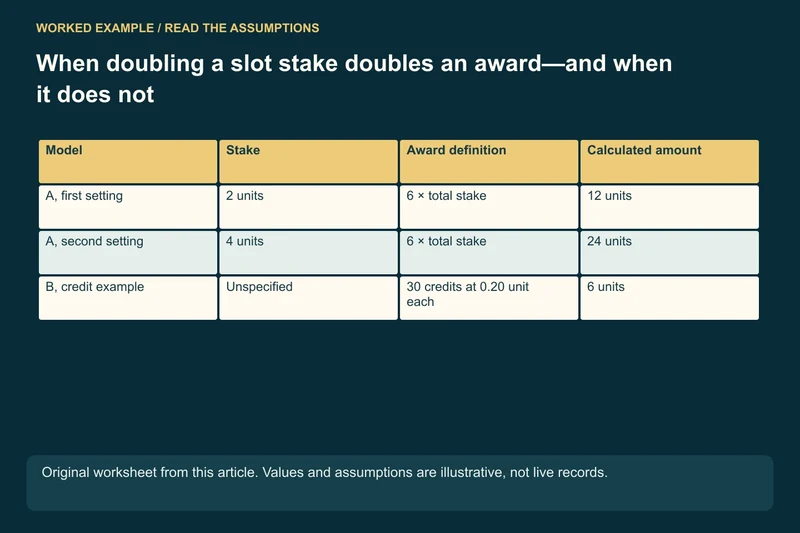
| Model | Stake | Award definition | Calculated amount |
|---|---|---|---|
| A, first setting | 2 units | 6 × total stake | 12 units |
| A, second setting | 4 units | 6 × total stake | 24 units |
| B, credit example | Unspecified | 30 credits at 0.20 unit each | 6 units |
Rows A demonstrate proportional scaling: the factor stays 6, the base doubles and the result doubles. Row B supplies a conversion, but it does not specify how that credit award changes with a different stake. Doubling its 6-unit result without another rule would be an assumption.
Check whether the comparison quietly changed modes
A higher setting can be accompanied by another paid option, a different number of active lines, a denomination change or a separate feature purchase. If any of those fields changes, the two records no longer isolate stake alone. Record the full accepted round cost rather than a small number near one control.
Even with a proportional base award, a cap, fixed component or rounding rule can change the final relationship. For example, an invented award of 6 × stake capped at 20 gives 12 at stake 2 but 20 at stake 4. The uncapped calculation is 24; the stated cap limits the accepted result.
Amount scaling does not establish chance
The worked rows are conditional on the specified combination occurring. They contain no information about how often it occurs. A doubled conditional payment is not proof of doubled win probability or improved return.
A reliable comparison keeps the exact edition, mode, qualifying combination, total stake, credit unit and cap together. If the screenshot omits one of them, leave that part unresolved. The arithmetic can be checked on paper without changing a real stake or starting another round.
The msw homepage brings together the site’s other reading topics.
Source-based editorial research and original examples. Sources checked 9 October 2026. No real-money play or account transaction was performed for this article.