
Two five-symbol clusters are not one ten-symbol cluster
Published — UTC

Ten identical symbols on a grid need not form a ten-symbol cluster. If the stated rule pays connected groups, two separate groups of five must be tested separately. Adding all matching symbols first answers a different question.
A grid with a deliberate gap
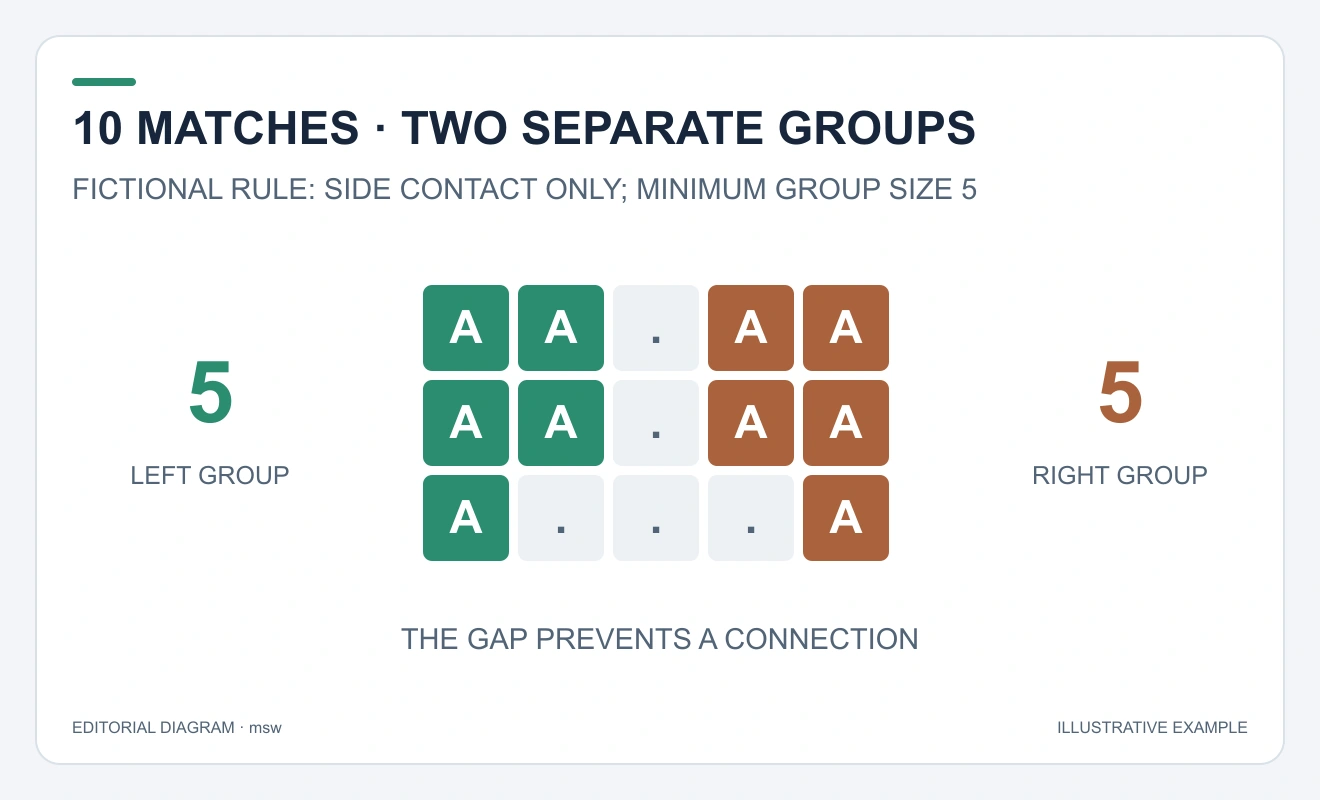
Use this invented rule: only horizontal or vertical contact connects A symbols; a group needs at least five A symbols to qualify. A dot is another symbol. This diagram is an original teaching example, not a game screenshot.
A A . A A
A A . A A
A . . . A
The left group has five A symbols. The right group also has five. The empty middle column prevents a connection between them. Both meet the fictional threshold, but neither contains ten symbols.
| Measurement | Value | Meaning |
|---|---|---|
| All A symbols | 10 | Whole-grid count |
| Largest connected group | 5 | Cluster size |
| Qualifying groups | 2 | Groups passing the stated threshold |
Trace a group without counting a square twice
- Start at an unmarked A and give it a group label.
- Visit its horizontal and vertical A neighbours, giving each the same label.
- Continue from newly labelled squares until no eligible neighbour remains.
- Count the labelled squares. Then start a new group from an unmarked A.
Keep a visited mark: a square reachable from two neighbours still belongs to the group once. Merely seeing several routes to that square does not increase the group’s size.
The real rule must supply the missing details
For a real example of cluster-based play, Play’n GO’s Reactoonz description identifies a 7×7 grid and groups of at least five matching symbols. Our smaller grid illustrates counting only; it is not that game’s layout, paytable or a claim that the title is available here.
A one-cell bridge changes the question
Replace the top row’s middle dot with A. That new cell touches both sides horizontally, so all the A symbols become one connected group of 11. It is not a ten-symbol group: the bridge itself must be counted. The remaining middle-column dots do not matter because a connected path already exists through the top row.
Now consider two A symbols touching only at a corner. Under our stated side-contact rule they remain separate. A diagram can look almost connected while failing the actual neighbour test. If an edition permits diagonal connections, use that edition’s rule instead; the original example deliberately does not.
Count again after a cascade
When winning symbols disappear and replacements fall, take a new grid snapshot. Group labels from the previous arrangement are no longer reliable. Do not carry a previously counted five-symbol group into a later cluster merely because some symbols occupy familiar positions.
For a reviewable record, write each group’s cell coordinates, size and symbol type, then compare that size with the paytable. A coordinate such as row 2, column 1 identifies a square more clearly than “the A near the left”. Keep Wild substitution and any oversized-symbol rules in a separate note; those rules can change which cells participate.
Group size still does not provide an award amount
Two eligible groups of five tell us which size entries to inspect, not their cash value. The paytable must supply the symbol’s award, the stake basis and how simultaneous groups combine. Do not substitute the ten-symbol row simply because the whole grid contains ten A symbols. If the required paytable is unavailable, the correct conclusion is “two groups of five identified; award unresolved”.