
Counting lotto matches: compare numbers, not screen positions
When a lottery entry is matched as an unordered set, a number can match even when it appears in a different column. Comparing the first displayed number with the first number on your entry, then the second with the second, can miss valid matches. Start with the product’s matching rule, then compare the complete sets.
This guide in the msw lottery section uses an invented six-number example to show the difference. It does not verify a real result, set a prize amount or approve a claim. Some digit products require an exact order, so their rules need a different comparison.
Six columns can show four matches and no same-position matches
Assume a fictional product selects six different numbers from 01 to 42 and counts matches without regard to display order. Entry E contains 03, 08, 14, 21, 29 and 37. Its correctly identified fictional draw displays 37, 14, 04, 29, 08 and 41.
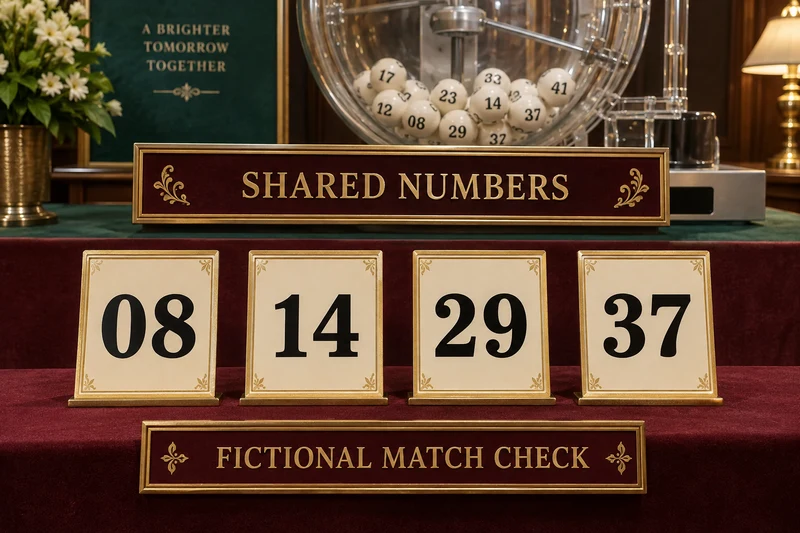
There are four shared numbers: 08, 14, 29 and 37. None is in the same displayed position in both rows. A column-by-column check would report zero, even though the stated unordered rule gives four matches. The two rows are valid six-number records; the error is the comparison method.
| Position shown | Entry E | Result row | Same position? |
|---|---|---|---|
| 1 | 03 | 37 | No |
| 2 | 08 | 14 | No |
| 3 | 14 | 04 | No |
| 4 | 21 | 29 | No |
| 5 | 29 | 08 | No |
| 6 | 37 | 41 | No |
Count the shared set once
The mathematical operation is a set intersection: keep the numbers present in both sets. OpenStax’s explanation of intersection describes this shared membership. It supplies the set concept, not lottery settlement rules. Here E ∩ R = {08, 14, 29, 37}, so the match count is four.
One practical way to review the fictional rows is to make a working copy of each and sort it in ascending order. The result becomes 04, 08, 14, 29, 37, 41. Mark each number that also appears in E, then list the marked numbers separately. Preserve the original result row and its source; sorting the working copy should not replace the evidence of what was displayed.
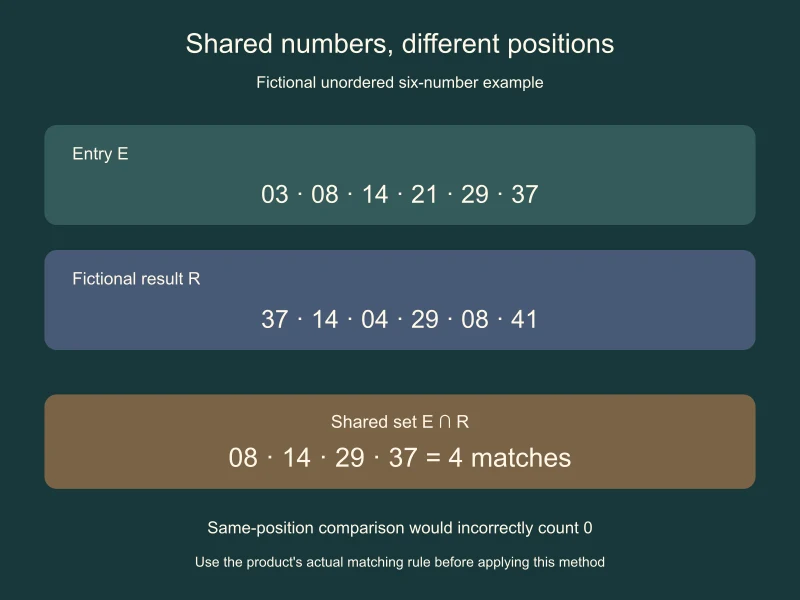
The unmatched entry numbers are 03 and 21. The unmatched result numbers are 04 and 41. These are useful cross-checks: four shared plus two unmatched equals six on each side. They do not add two more matches or create a second entry.
A repeated field is a record problem, not an extra match
Suppose a copied result reads 37, 14, 04, 29, 08, 37 instead. It has six fields but only five distinct numbers. That conflicts with this example’s six-different-number rule. Do not silently remove one 37, guess the missing number or treat the repeated 37 as two matching balls.
Mark the copied result as inconsistent and return to its authoritative source. A set comparison alone can hide duplicates by discarding them, so validate the number of fields, distinct values and allowed range before counting the intersection. A blank or unreadable field should remain unresolved until the source is recovered.
The correct row comes before the arithmetic
Check the full game name, draw date, session where applicable and the result’s source. Another product can display six numbers in the same range, but that does not make its result relevant to Entry E. A well-calculated intersection with the wrong draw is still the wrong comparison.
On a phone, keep the row identity while moving across a wide table. The guide to reading a lotto table without losing the game and date covers clipped headings and adjacent-row confusion. If a screenshot shows only the combination, recover the missing identity rather than infer it from nearby text.
Keep unordered numbers separate from ordered digits
For an exact-order digit product, moving a digit to another position may change the entry. The sequence 037 is different from 370 under an exact-order rule, even though both contain the digits 0, 3 and 7. Do not borrow the set method from this six-distinct-number example for that product.
Likewise, a game may have a separately labelled bonus or additional number. Its role comes from the specific rule; it should not be inserted into the main result set merely because it appears beside the six main numbers. This guide makes no claim about a current product’s bonus ball or prize bracket.
Write the result of the check clearly
A useful note for this example is: “Entry E; assumed unordered six-number rule; fictional result R; shared numbers 08, 14, 29, 37; match count four.” Keep the product and draw identity with that note. A match count alone leaves out the rule and record that produced it.
Four matches are an input to the applicable prize rules, not a payment confirmation. Check the current award table and accepted-entry record separately. Sources and the invented comparison were checked on 10 October 2026; no ticket, live result or claim was processed.